
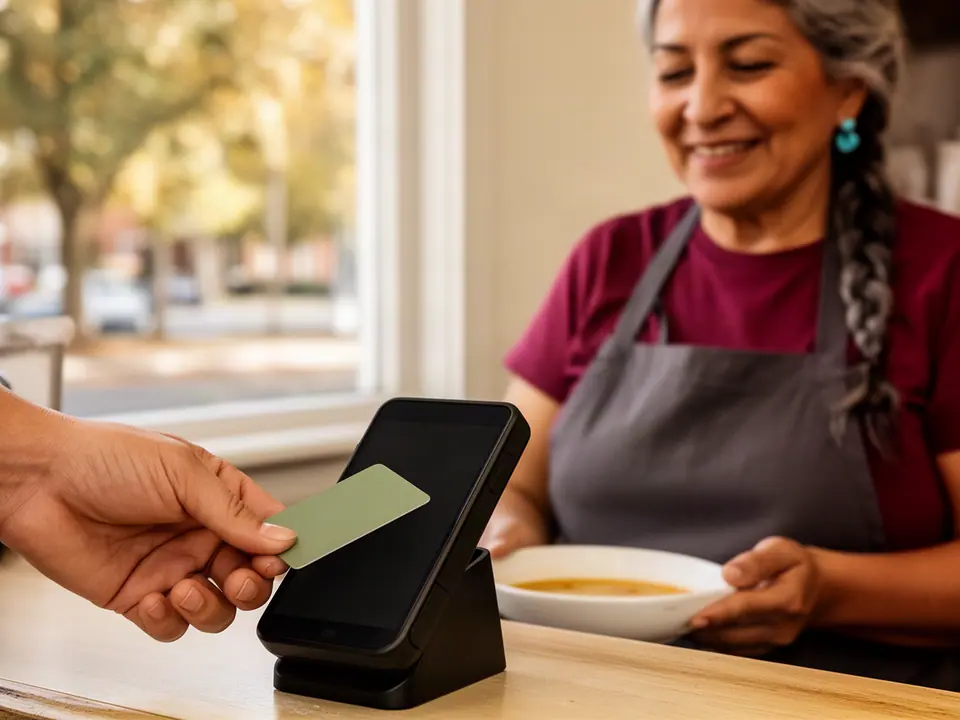
Cash now in exchange for a slice of the card sales still to come: that is the deal behind a merchant cash advance. This page explains what that means, how the factor rate and holdback set the cost, and where an advance fits for grocers, restaurants, repair shops and law firms.
At a glance
- Accommodation and food services, Cumberland County, NJ
250 employer establishments (CBP 2023, NAICS 72)
- Retail trade, ZIP 08302
117 employer establishments with a ZIP 08302 address (ZBP 2023)
- Grocery stores, Cumberland County, NJ
66 employer establishments, convenience stores included (CBP 2023, NAICS 4451)
Revenue-Based Financing vs. a Merchant Cash Advance for Bridgeton, NJ Law Firms
Revenue-based financing and a merchant cash advance both take payment from the business's sales, and that is where the likeness ends. Revenue-based financing is a loan that takes a share of total monthly revenue until a set cap is reached. A merchant cash advance is not a loan at all: the provider buys a stated amount of future card receipts at a discount and collects them from card deposits.
For a law firm, the difference turns on how clients pay. A firm that takes retainers and fees by check or bank transfer has little card volume for an advance to draw on. A firm that runs client payments through a card terminal has a stream an advance can be collected from. Legal services employers in Cumberland County, NJ numbered 50 in 2023 (CBP, NAICS 5411), and how each of them takes payment decides which product even applies.
This site arranges merchant cash advances. Revenue-based financing is described here for comparison only.
What Is Merchant Cash Advance MCA? The Short Version for Bridgeton, NJ Grocers
A merchant cash advance, or MCA, gives a grocer a lump sum in exchange for a share of its future card sales. The provider sets a factor rate, which fixes the total to be collected, and a holdback, which is the share of each day's card deposits it takes until that total is met.
Illustration only, invented figures: a grocer accepts a $20,000 advance priced at a 1.28 factor rate. The total to be collected is $25,600, so the advance costs $5,600. With a 12% holdback and $2,100 of card sales on an average day, the provider collects about $252.00 a day, and the total is reached in roughly 102 business days. Slower card days stretch that out; busier ones shorten it.
Because the holdback is a percentage, the daily amount follows card volume. A fixed daily debit, which some offers use instead, does not, so the collection method in an offer matters as much as its factor rate.
The calculator on this page takes the four numbers from an offer, the advance, the factor rate, the holdback and average daily card sales, and returns the total collected, the cost and the estimated time to collect.
What Does Merchant Cash Advance Mean? An Example With Wheel Balancers
Put plainly, a merchant cash advance means selling part of tomorrow's card sales today. An auto repair shop that needs a wheel balancer and a tire changer before a run of booked jobs can take an advance and let the provider collect from card payments as cars go out the door.
Illustration only, invented figures: an $8,000 advance priced at a 1.24 factor rate sets $9,920 to be collected. At a 10% holdback on $950 of daily card sales, about $95.00 comes out each day, and the full amount is collected in roughly 105 business days.
For a single machine with a long life, equipment financing can cost less, because the machine secures the deal and the term can run for years. An advance trades that lower cost for collection that rises and falls with sales.
Merchant Cash Advance: Bulk Buys and Shelving at a Grocery Store
A grocer that sees a chance to buy a truckload of canned goods or paper products at a discount has days, not weeks, to pay. An advance can fund that bulk buy and be collected from the card sales the goods bring in.
Shelving to hold the extra stock is a different cost. It is a fixture with a long life and fits equipment financing, while repeated restocks fit a line of credit. An advance makes sense for the one-time buy when card sales are steady and the discount on the goods is larger than the cost of the advance.
- Compare the discount on the bulk buy with the cost of the advance
- Check the daily holdback against an ordinary day of card sales
- Confirm whether the offer allows a second advance before the first is collected
- Read how the provider handles a day with no card sales
By Southshire Business Capital · Updated